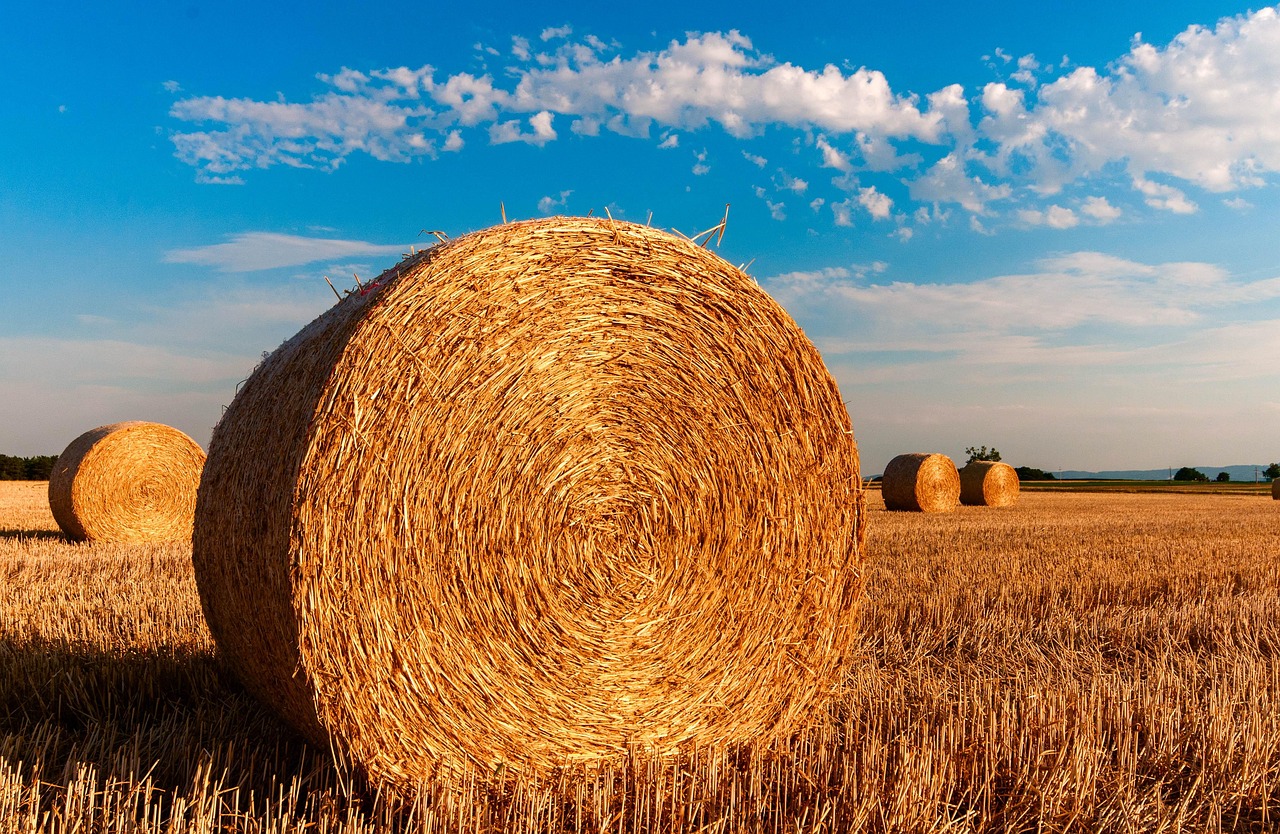
I want to say plainly why I baked, because my sister thought it was foolishness and told me so on the telephone, the way she tells me most things, fast and certain, like she’s reading off a label. I told her I did not have time to argue it with her, not that morning, and she said, Karen, you are going to drive into three yards and give people pie before you tell them they’ve been robbing a widow, and I said that was about the size of it, yes.
I was about to drive into three yards and tell three households that they had my hay and I wanted it back. Every one of them had paid for it. Every one of them thought they had done a kindness. You do not walk up to people like that empty-handed and start in. Not where I come from. You bring something, you sit down, and you tell it straight.
I made three rhubarb pies with lard crust, the way Tom’s mother taught me the first year we were married, standing at her stove in a kitchen that smelled like coffee and cut hay, correcting my hands without ever once raising her voice. I had the pies out of the oven by one in the morning. Ben came down at five and found me asleep in the chair with my apron still on, flour dried white along one forearm where I’d leaned on the counter without noticing.
“You want me to come?” he said.
“I want you to grease the loader on the 4020 and make sure the bale spear’s on it,” I said. “And then I want you to wait.”
“Wait for what?”
“I don’t know yet.”
That was the truth too. I did not know if anybody was coming.
To understand why I was sitting in that chair at five in the morning with three pies cooling on the counter, you have to go back a week, to a Tuesday morning that started like any other, with my boots still wet from the dew on the north eighty and no notion at all of what was waiting for me at my own kitchen table.
Dwayne said it at my kitchen table on a Tuesday morning, three days after we buried his brother. He said it the way a man tells you the price of diesel. He had his cap on his knee and a cup of my coffee in front of him, and behind him on the counter sat eleven casserole dishes with masking tape on the bottoms so I would know whose was whose, because that is what a Nebraska community does when a man dies in the middle of his own hayfield at fifty-three years old. They bring food. They do not know what else to bring.
I had just come in from the north eighty. My boots were still wet from the dew.
“Say that again,” I said. I did not say it loud.
“I said you don’t need it.” He turned the cup a quarter turn on the oilcloth, the way he does when he’s working himself up to something, a habit he’s had since we were all young together and he’d sit at this same table waiting to ask Tom for the loan of the grain truck. “I baled it Thursday night and Friday night, like I told you I would. Two hundred and twelve bales. Good hay, too. Tom laid it down pretty.”
“I know how many. I walked up there this morning to look at them.”
“Then you saw they’re gone.”
“I saw the twine ends and the tire tracks, Dwayne. That’s all I saw.”
He nodded as if I had agreed with him about something.
“I sold them,” he said. “All of it. Seventeen hundred dollars. And by the time I took out twine and fuel and two nights of my time, it about came out even. So there’s nothing to hand you, and I didn’t figure you’d want me making up a number.”
I am going to tell you what seventeen hundred dollars means, in case you have never bought hay. It means eight dollars a bale. That summer a big round bale of alfalfa and brome, twelve hundred pounds of it, was bringing seventy dollars anywhere in Custer County, and more if you could wait until January. Two hundred and twelve bales was close to fifteen thousand dollars standing in my field. I did that arithmetic sitting right there at the table, automatically, the way you do sums you’ve done your whole life, and I watched the number arrive and understood, in the same instant, that my brother-in-law had not made a mistake. A mistake is when you misjudge a price. This was something else.
He had not sold my hay. He had gotten rid of it.
“Eight dollars a bale,” I said.
“I wanted it gone quick.” He finally looked at me. Dwayne has Tom’s eyes, the same pale gray, and that week I could hardly stand to see them in another face, because every time he looked at me straight I felt my husband looking back out of a stranger. “Karen, be sensible. You’ve got forty pairs on summer grass and a boy who’s still in high school. You are not going to feed cows through a Nebraska winter by yourself. You’ll have them at the sale barn by October, and you know it. And a woman with no cows does not need hay.”
“And when the cows are gone?”
“Then you’ll want to talk about the place.” He set his cap on his head. “When you do, you talk to me first. That’s Dad’s ground. It ought to stay with the name.”
So there it was, all of it, laid out on my table next to the sugar bowl, plain as a grain elevator receipt. No hay meant no cows. No cows meant no reason to keep a quarter section eleven miles out of Broken Bow. And a widow with no reason to stay will take the first offer from family, especially if family is the one who has been so much help, who brought the tractor around to mow the yard without being asked, who showed up at the funeral home with the right suit already pressed.
I looked at the casserole dishes. I looked at Tom’s chore coat, still on its nail by the door, because I had not been able to make my hand take it down.
I did not scream. I have never been a screamer, and I was too tired that week to start.
“Well,” I said. “Thank you for the trouble, Dwayne.”
He blinked. I do not think it was what he had come braced for.
“It was two nights of work,” he said.
“I know it was. I brought you out a sandwich Thursday, remember? And a thermos.” I had. I had walked it up over the hill at ten o’clock at night, with the baler lights going back and forth in the dark, and I had stood at the fence and cried because my husband’s brother was putting up my husband’s hay, and I had told myself that the crying was only grief finding a new place to land, that it was good of Dwayne to do it, that I should be grateful. “I just have one question.”
“All right.”
“Who bought them?”
He could have refused to tell me. But Dwayne was proud of how fast he had moved it, and I believe some part of him thought that if I heard the names, good names, neighbors, I would understand it was settled and could not be undone.
“Arlen took eighty,” he said. “Gene Pokorny took a hundred for his backgrounding lot. And that young couple on the oil road, Steve and Kim, they took the last thirty-two for her horses.”
“Arlen,” I said.
“He came Sunday afternoon with his flatbed. Gene sent the semi Monday while you were gone to Kearney.”
Arlen had stood at the grave on Saturday with his hat against his chest. He was seventy-eight years old and he had held my elbow going back to the car.
“What did you tell them?”
Dwayne’s ears went red. It was the only sign he gave, the whole morning, that he knew what he had done.
“I told them you were selling out,” he said. “That you wanted the field cleaned off, and the neighbors might as well have it for the cost of the baling.”
“So they think I gave it to them.”
“They think they did you a favor.”
I got up and poured his coffee down the sink, because it had gone cold and because I needed to do something with my hands.
“Dwayne,” I said, with my back to him. “It is Tuesday. Every one of those bales could be back along that road fence by Sunday, and nobody would ever have to hear one word about it from me. Not one. I mean that.”
It was quiet long enough that I heard the clock.
“It’s done, Karen,” he said.
The screen door slapped behind him. His pickup started. Pete, our old black-and-white dog, did not get up off the porch to see him go, and Pete got up for everybody.

Adrian Hawthorne is a celebrated author and dedicated archivist who finds inspiration in the hidden stories of the past. Educated at Oxford, he now works at the National Archives, where preserving history fuels his evocative writing. Balancing archival precision with creative storytelling, Adrian founded the Hawthorne Institute of Literary Arts to mentor emerging writers and honor the timeless art of narrative.