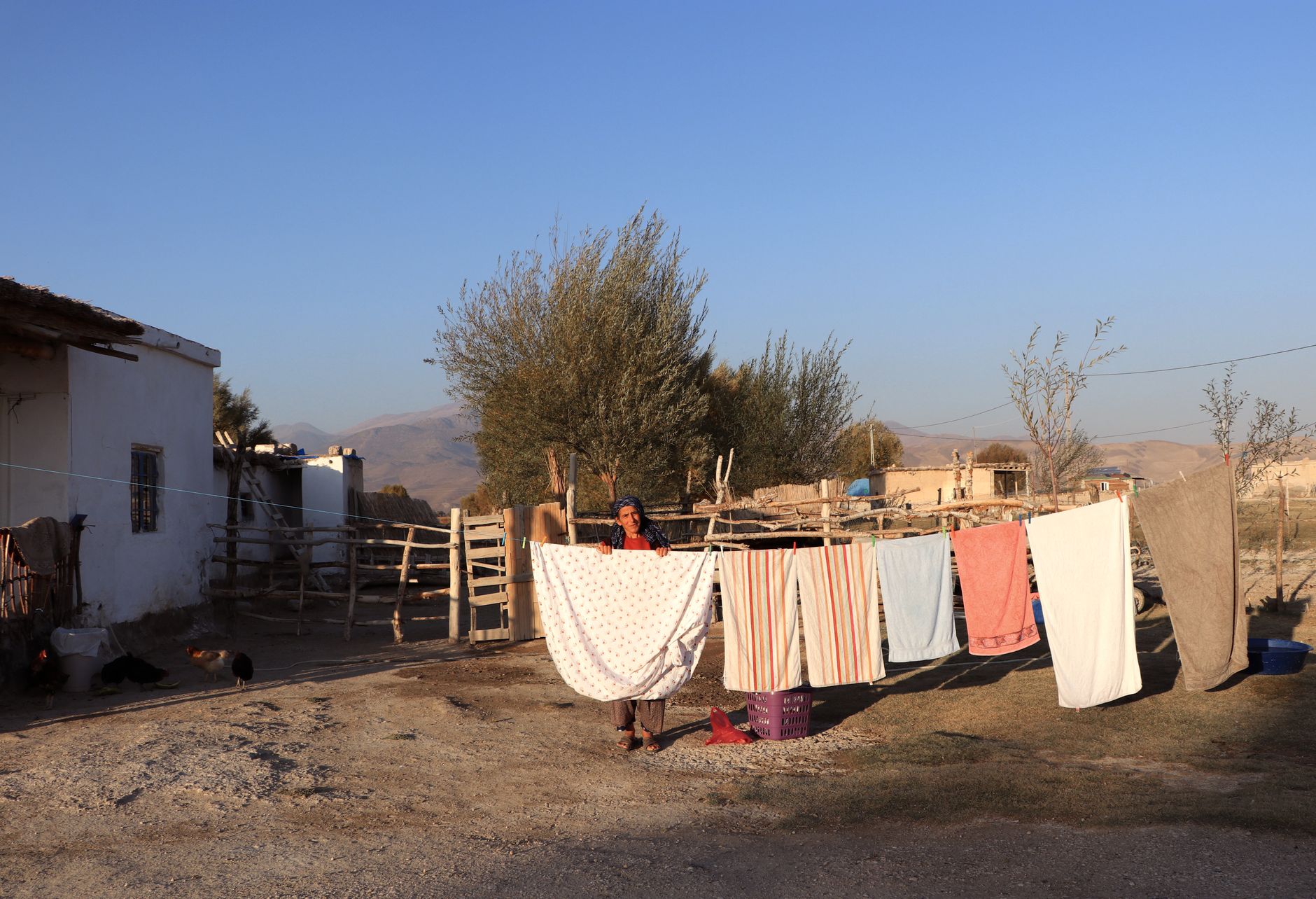
“It’s what she did.” He cleared his throat. “Bud says it wasn’t only sheets. He says Doris told him there was a quilt.”
“Come in, Lyle.”
This time he came. He wiped his boots four times on a mat that did not need it.
I took him down the hall. The quilt was still spread on the spare bed with the windows open and the fan going. A week of air had lifted a little of the gray. It had not lifted the smell.
“This was on the line last Monday.”
He stood in the doorway with his cap against his chest.
“I thought it was a blanket,” he said. “From the fence. I thought you were drying a blanket.”
“It’s my mother’s wedding quilt. Her mother pieced it. Nineteen fifty-four.” I turned back the corner so he could read the floss. “It’s never been in a washing machine. It’s never been anywhere but a cedar chest and that clothesline.”
He bent and read it. Irene and Walter. Then, because I suppose he had to know, he lowered his face a few inches and breathed in.
He straightened up slowly.
“That’s my bread bags,” he said.
“Yes.”
“On Irene’s quilt. And I stood there and told you it was good for your sinuses.”
“You did.”
“Lord have mercy.” He shook his head. “Sandra, I’m sorry. I am. I’m not saying it because Bud came. I’m saying it because I just smelled it.”
“I know you are.”
“Can it be fixed?”
“There’s a woman in Norfolk who’ll try. By hand, in a tub. She wouldn’t promise on the smell, or on the pink.”
“What’s she charge?”
I hesitated. It is an uncomfortable thing to name a sum to an old man on a pension, in your own spare room.
But Doris had said a thing to me by her car that morning. She said, “Don’t you let him off the money, Sandra. It’s no kindness. A man who’s done wrong and isn’t allowed to pay for it has to carry it around the rest of his life.”
“Eighty-five dollars,” I said.
He had his wallet out before I finished the word. Four twenties and a five, counted onto the dresser, squared up with the side of his hand.
“If it runs over, you tell me.”
“I will.”
“And if she can’t get it out.” He stopped. “Well. I don’t know what a man does then.”
“Then it’ll be a quilt that’s been through something,” I said. “Same as the rest of us. It’ll still go on the line in May.”
We went back to the kitchen, and now he sat, and I poured him coffee and cut him a square of the coffee cake Doris had approved.
“There’s another piece to this,” I said. “You’ve got to do something with your trash.”
“Bud said the same. I’ll haul it to the transfer station, I guess.”
“That’s twenty miles round trip and they charge by the bag. Lyle, why’d you quit the pickup?”
He turned his cup a quarter turn.
“Thirty-one dollars a month for a fella who makes one bag a week. It seemed foolish. Joan handled the bills, and when I started handling them, I went down the list looking for foolish.”
“What if it was fifteen-fifty?”
“How’s that?”
“I’ve got a cart that’s never more than half full with Tom gone five days a week. You bring your bag over Wednesday night and drop it in mine. We split the bill. Thirty-one dollars, fifteen-fifty apiece.”
I could see his pride get up on its hind legs. I could also see him doing the arithmetic, because he is that kind of man.

Sophia Rivers is an experienced News Content Editor with a sharp eye for detail and a passion for delivering accurate and engaging news stories. At TheArchivists, she specializes in curating, editing, and presenting news content that informs and resonates with a global audience.
Sophia holds a degree in Journalism from the University of Toronto, where she developed her skills in news reporting, media ethics, and digital journalism. Her expertise lies in identifying key stories, crafting compelling narratives, and ensuring journalistic integrity in every piece she edits.
Known for her precision and dedication to the truth, Sophia thrives in the fast-paced world of news editing. At TheArchivists, she focuses on producing high-quality news content that keeps readers informed while maintaining a balanced and insightful perspective.
With a commitment to delivering impactful journalism, Sophia is passionate about bringing clarity to complex issues and amplifying voices that matter. Her work reflects her belief in the power of news to shape conversations and inspire change.